Have you ever followed a mayonnaise recipe exactly, only to watch it turn into a thin, oily mess? Or perhaps your garlic dip split just before serving. It feels frustrating, especially when the ingredients were fresh and the measurements were correct. The truth is that recipes are rarely the problem. More often, the missing piece is understanding how an emulsion works.
I learned this lesson early in culinary school. Like every young chef, I spent hours making mayonnaise over and over again. At the time, it felt like just another recipe to memorize. However, everything changed when I started working in a French restaurant. There, I quickly realized that mayonnaise was never the real lesson. The real lesson was learning how to build and maintain a stable emulsion.
Once I understood that principle, many other sauces suddenly made perfect sense. Hollandaise, vinaigrettes, aioli, and countless dressings all relied on the same technique. Even today, after decades in professional kitchens, I still believe that mastering emulsions is one of the most valuable skills any cook can learn.
Instead of memorizing dozens of recipes, you learn one simple culinary principle that you can use again and again. That is exactly why every professional chef studies emulsions from the very beginning of their training.
One Technique, Countless Sauces
Once you understand how an emulsion works, you stop seeing mayonnaise, garlic dip, and salad dressings as separate recipes. Instead, you begin to recognize that they all follow the same idea.
That is why learning this technique will help you prepare much more than homemade mayonnaise. The same knowledge applies to creamy garlic dip, tartar sauce, cocktail sauce, Thousand Island dressing, Caesar dressing, and many other sauces you will use in your kitchen. In fact, several recipes on this website begin with the same foundation, even though they taste completely different in the end.
More importantly, understanding emulsions also helps you fix mistakes. Instead of wondering why a sauce broke, you will know exactly what happened and how to prevent it the next time.
In this guide, I will explain the science in simple words and share the practical lessons I learned both in culinary school and in professional restaurant kitchens. Once you understand the technique, creating smooth, creamy, and stable sauces becomes much easier.
What Is an Emulsion? (Without the Complicated Science)
At its simplest, an emulsion is a mixture of two liquids that normally do not stay together. The most common example is oil and water. If you pour them into a glass and leave them for a few minutes, they quickly separate into two distinct layers.
That happens because oil and water have different molecular structures. Water molecules attract each other, while oil molecules do the same. Instead of mixing, they naturally pull away from one another.
An emulsion changes that behavior.
When you slowly break the oil into millions of tiny droplets and spread them throughout the water, the mixture becomes smooth and creamy instead of separating. However, those droplets need help staying apart. Otherwise, they quickly join together again, and the sauce breaks.
Think of it like a crowd of people. If everyone stands in one big group, they are easy to recognize. Now imagine spreading that same crowd across an entire stadium. They become much harder to gather back together. Oil droplets behave in a similar way. The smaller and more evenly they are dispersed, the more stable the emulsion becomes.
This is where an emulsifier comes in. An emulsifier acts like a bridge between oil and water. It helps the tiny droplets remain suspended instead of merging back into one large pool of oil.
Different sauces use different emulsifiers. In mayonnaise, the egg yolk does the job thanks to the lecithin it contains. In traditional garlic dip, finely crushed garlic creates the structure that holds the oil in place. Mustard can also strengthen an emulsion, which is one reason many chefs add a little to homemade mayonnaise.
More Than Just Mayonnaise
Once you understand this simple principle, you will start noticing emulsions everywhere in the kitchen.
Mayonnaise is one example, but it is far from the only one. Garlic dip, hollandaise sauce, Caesar dressing, ranch dressing, tartar sauce, cocktail sauce, Thousand Island dressing, and many vinaigrettes all rely on the same idea. They may use different ingredients, but they all depend on keeping oil and water working together.
That is why professional chefs spend so much time learning this technique. They are not simply learning one recipe. They are mastering a cooking skill that applies to dozens of sauces, dressings, and dips they will prepare throughout their careers.
The Three Building Blocks of Every Stable Emulsion
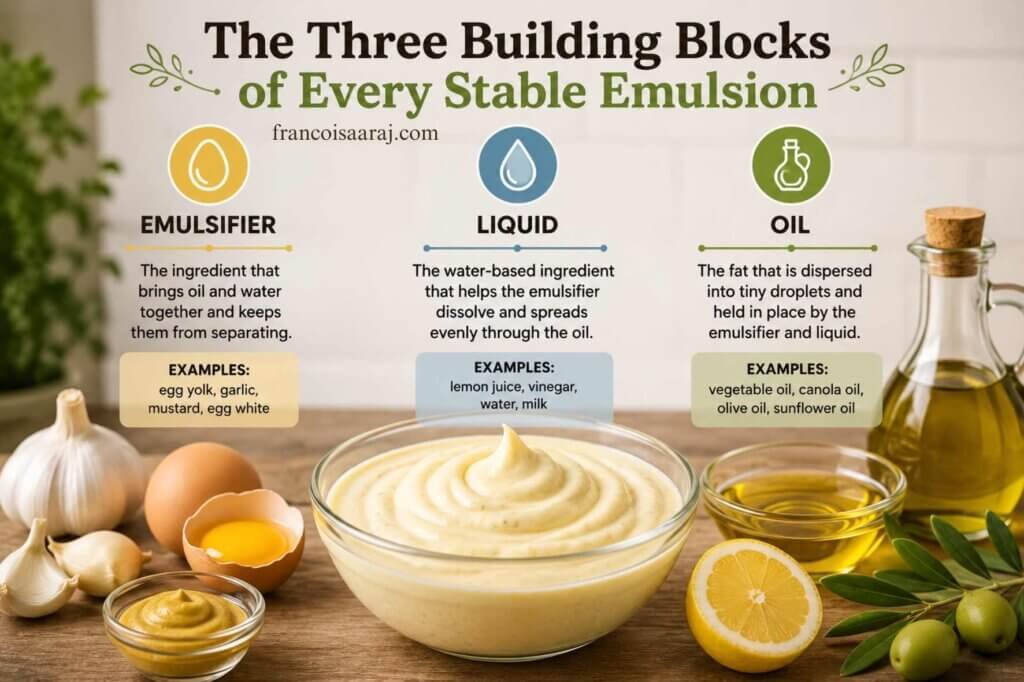
Although every sauce has its own ingredients, every successful emulsion is built on the same three elements. Once you understand how they work together, you will find it much easier to create smooth, stable sauces instead of relying on luck.
1. A Fat
Every emulsion starts with a source of fat. In most cold sauces, that fat is oil. In warm sauces like hollandaise, it is melted butter. Other recipes may use cream or different fats depending on the final texture and flavor.
The type of fat changes the taste of the sauce, but it does not change the basic principle. Your goal is always the same: break the fat into countless tiny droplets and keep them evenly distributed throughout the liquid.
2. A Water-Based Liquid
The second part of the emulsion is the water phase. Depending on the recipe, this can come from lemon juice, vinegar, water, egg yolks, egg whites, garlic, or even milk.
Many people think mayonnaise is simply oil mixed with egg yolks. In reality, the water naturally present in the egg yolks, along with the vinegar or lemon juice, forms the liquid phase that allows the emulsion to develop.
The same idea applies to garlic dip. Although it contains a large amount of oil, the garlic itself, together with lemon juice and any added water, provides the moisture needed to build the emulsion.
3. An Emulsifier
This is the ingredient that holds everything together.
An emulsifier has a unique ability to interact with both oil and water. It surrounds the tiny oil droplets and helps prevent them from joining back together. As a result, the sauce stays thick, creamy, and stable instead of separating.
Different recipes use different natural emulsifiers. Egg yolks contain lecithin, which makes them perfect for mayonnaise. Garlic releases compounds that help stabilize traditional toum. Mustard also has natural emulsifying properties, which is why many chefs include a small amount in mayonnaise even when they are not looking for a strong mustard flavor.
Without an emulsifier, you can whisk as much as you like. The ingredients may come together for a few moments, but they will eventually separate because nothing is keeping the oil droplets apart.
Think of It Like Building a House
A stable emulsion needs all three parts working together. The fat provides richness, the water phase allows the ingredients to combine, and the emulsifier acts as the structure that keeps everything in place.
If one of these elements is missing or not handled correctly, the sauce becomes unstable. That is why professional chefs focus less on memorizing ingredient lists and more on understanding how each ingredient contributes to the final result.
Why Egg Yolks Create Such a Stable Mayonnaise
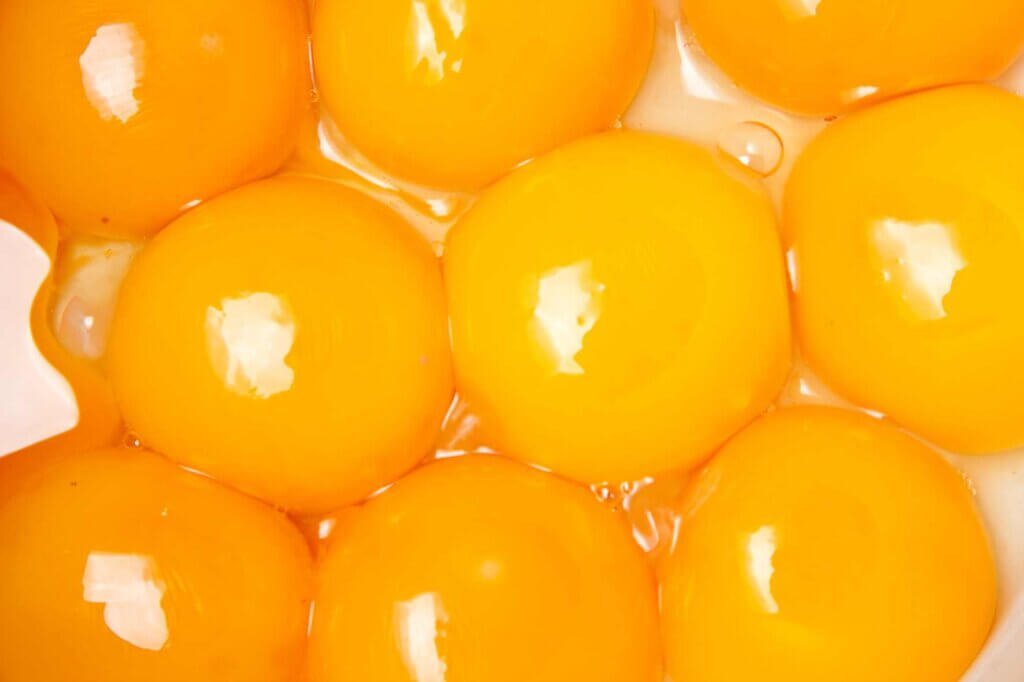
If there is one ingredient that teaches young chefs the science of emulsions, it is the egg yolk.
At first glance, an egg yolk does not seem very special. Yet it contains one of nature’s best emulsifiers: lecithin. This natural compound has the remarkable ability to bind with both oil and water at the same time. As you slowly add the oil, the lecithin coats each tiny droplet and helps keep it suspended throughout the mixture instead of allowing it to separate.
That is why mayonnaise can contain a surprisingly large amount of oil while still remaining thick, smooth, and creamy.
However, even the best emulsifier has its limits.
If you pour the oil too quickly, the egg yolk cannot coat the new droplets fast enough. Instead of forming one stable mixture, the oil joins together in larger droplets until the mayonnaise eventually breaks. This is why patience is one of the most important ingredients in the recipe.
The Secret Is Not More Whisking
Many beginners believe they simply need to whisk harder or faster. In reality, the speed of the whisk is far less important than the speed at which the oil is added.
Professional chefs usually begin by adding the oil drop by drop. Once the emulsion forms and becomes stable, they gradually increase the flow to a thin, steady stream. This gives the lecithin enough time to surround each new droplet of oil before more is added.
It may feel slow at first, but those extra minutes are what create a mayonnaise that stays smooth instead of separating.
If you would like to see the complete process step by step, take a look at my homemade mayonnaise recipe, where I explain the technique in detail and show exactly how to build a stable emulsion from the very beginning.
A Good Emulsion Is More Than Thick
Many people judge mayonnaise by its thickness alone. While thickness is important, it is not the true sign of a successful emulsion.
A well-made mayonnaise should also be glossy, smooth, and uniform from the first spoonful to the last. You should not see small pools of oil, grainy patches, or liquid collecting around the edges. Those are early signs that the emulsion is becoming unstable.
Once you learn to recognize these details, you will no longer rely on luck. Instead, you will understand what your sauce is telling you and know how to adjust your technique before it fails.
The same principle applies to another famous sauce that contains no egg yolks at all: traditional garlic dip. Although it uses completely different ingredients, it follows the very same rules of emulsion, and that is exactly what we’ll explore next.
How Garlic Dip Builds a Stable Emulsion
Unlike mayonnaise, garlic dip can be prepared in more than one way. Some recipes rely entirely on fresh garlic as the emulsifier, while others include egg whites to make the emulsion easier to build and more forgiving for beginners.
I teach both methods because each has its advantages. The traditional version showcases the natural emulsifying power of garlic, while the egg white version creates a stable, creamy sauce with a little less effort. Although the ingredients differ slightly, both recipes follow exactly the same culinary principle.
Garlic Alone Can Hold the Oil
In the traditional recipe, finely crushed garlic releases natural compounds, including proteins and carbohydrates, that help stabilize tiny droplets of oil. As long as the garlic is processed into a smooth paste and the oil is added gradually, the mixture transforms into the thick, fluffy white dip we all know and love.
This method takes patience and careful technique, but it produces an authentic garlic dip with a bold garlic flavor.
Why Some Recipes Use Egg Whites
In the second method, egg whites contribute proteins that strengthen the emulsion. They do not replace the garlic; instead, they work alongside it to help the sauce come together more easily and remain stable.
For many home cooks, this version is less likely to break, especially when preparing large batches or when using a blender.
Whether you choose the traditional recipe or the version with egg whites, the same rule always applies: add the oil gradually and give the emulsifier time to surround each tiny droplet.
Why Professional Chefs Always Add the Oil Slowly
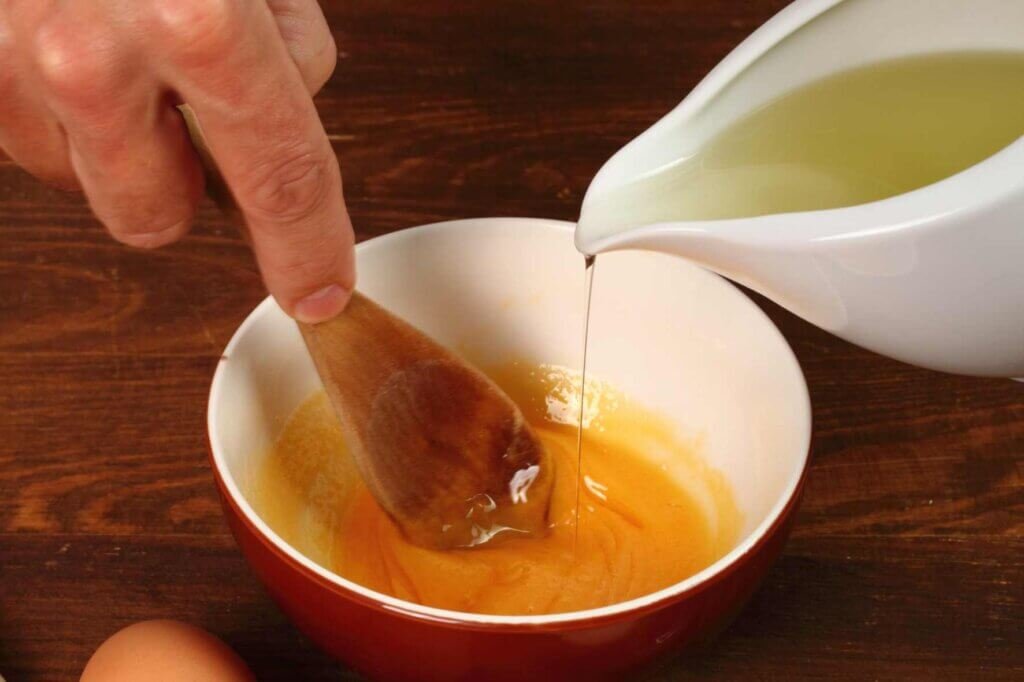
If I had to choose one habit that separates successful emulsions from broken ones, this would be it.
Professional chefs do not add the oil slowly because it is a tradition. They do it because the science demands it.
Every drop of oil you add needs to be broken into thousands of microscopic droplets before the next one arrives. At the same time, the emulsifier must coat those droplets to keep them from merging back together. If the oil enters the mixture faster than the emulsifier can handle it, the droplets combine into larger ones, and the emulsion begins to fail.
That is exactly what happens when mayonnaise or garlic dip suddenly turns oily.
Start Slow, Then Increase the Speed
When making mayonnaise or garlic dip, I always begin by adding the oil one drop at a time. I know it requires patience, but this is the stage where the emulsion is still fragile.
Once the mixture starts to thicken and you can see that it has become stable, you can gradually pour the oil in a thin, steady stream. At this point, the emulsion is much stronger and can accept more oil without breaking.
Trying to save time during the first few minutes often ends up costing much more time because you have to start over or repair a broken sauce.
The Blender Does Not Do the Thinking
Many people believe that using a powerful blender guarantees success. In reality, the blender is only a tool.
Even the most expensive food processor cannot build a stable emulsion if the oil is poured in too quickly or if the ingredients are out of balance. Likewise, skilled chefs have been making perfect mayonnaise by hand with nothing more than a whisk for generations.
Good equipment can make the work easier, but it cannot replace good technique.
Watch the Sauce, Not the Clock
One of the best lessons I learned in professional kitchens was to pay attention to the sauce instead of the recipe.
As the emulsion forms, you will notice it becoming thicker, smoother, and glossier. These are the signs that it is ready to accept more oil. If it still looks thin or unstable, keep pouring slowly and let the emulsion strengthen before increasing the flow.
Learning to read these visual cues is far more valuable than memorizing how many seconds to pour or how many minutes to blend. It is a skill that will serve you every time you prepare an emulsified sauce, whether it is mayonnaise, garlic dip, or one of the many dressings and dips built on the same principle.
Why Emulsions Break
There are few things more frustrating than watching a smooth, creamy sauce suddenly separate into oil and liquid. Whether you are making mayonnaise, garlic dip, or hollandaise, the result always looks the same: the emulsion loses its structure, and the ingredients drift back to where they naturally want to be.
Fortunately, a broken emulsion is rarely a mystery. In most cases, one of a handful of common mistakes is responsible.
Adding the Oil Too Quickly
This is, without question, the most common cause of a broken emulsion.
An emulsifier can only coat a limited number of oil droplets at a time. When too much oil is added too quickly, the droplets begin to merge before they can be stabilized. Instead of one smooth mixture, you end up with large pockets of oil that the emulsifier can no longer control.
That is why professional chefs always begin slowly. Once the emulsion becomes strong enough, it can safely accept more oil.
The Wrong Balance Between Ingredients
Every emulsion has a limit.
If there is too much oil and not enough liquid or emulsifier, the sauce eventually reaches a point where it cannot hold any more fat. Once that balance is lost, the emulsion starts to separate.
This is why following the ingredient ratios is just as important as following the technique. Even experienced chefs respect these proportions because they are based on the science of the emulsion rather than personal preference.
Not Preparing the Emulsifier Properly
Sometimes the problem starts before the oil is even added.
For example, if the garlic is only roughly chopped instead of being processed into a smooth paste, it cannot create a strong structure to support the emulsion. Likewise, if the egg yolk is not fully combined with the lemon juice or vinegar before adding the oil, the mayonnaise has a weaker foundation from the beginning.
Taking an extra minute to prepare your ingredients properly often prevents much bigger problems later.
Temperature Can Make a Difference
Although temperature is not usually the main reason an emulsion fails, it can certainly make the process more difficult.
Very cold ingredients may slow the formation of the emulsion, while excessive heat can destabilize warm sauces such as hollandaise or béarnaise. This is why many chefs prefer to work with ingredients that are cool or at room temperature, depending on the recipe they are preparing.
More importantly, avoid sudden temperature changes. A stable emulsion likes consistency.
Rushing the Process
Over the years, I have learned that impatience is responsible for more failed sauces than any piece of equipment or ingredient.
Home cooks often try to speed things up by pouring the oil faster or skipping small steps that seem unnecessary. However, emulsions reward patience. Giving each stage enough time to develop almost always leads to a smoother, stronger, and more stable sauce.
The good news is that even if an emulsion does break, your work is not necessarily lost. In many cases, you can rebuild it instead of throwing it away. That is exactly what we’ll look at in the next section.
How to Rescue a Broken Emulsion
The first time a mayonnaise or garlic dip breaks, most people assume they have to throw it away and start over.
Fortunately, that is not always true.
In many cases, the ingredients are still perfectly usable. The emulsion simply needs a new starting point. Professional chefs rarely panic when a sauce separates because they know that many broken emulsions can be rebuilt with the right technique.
How to Fix a Broken Mayonnaise
If your mayonnaise separates, don’t keep adding more oil. That usually makes the problem worse.
Instead, start with a new egg yolk in a clean bowl. Whisk it together with a teaspoon of water or a little lemon juice. Then, instead of adding fresh oil, slowly drizzle the broken mayonnaise into the new egg yolk, just as if you were making mayonnaise from the beginning.
The new egg yolk provides fresh lecithin, giving the emulsion another chance to form. As long as you add the broken mixture gradually, the mayonnaise often comes back together beautifully.
How to Fix a Broken Garlic Dip
The best repair method depends on the recipe you are making.
If you are preparing the traditional garlic dip, begin with a small amount of freshly crushed garlic in a clean food processor. Once it forms a smooth paste, slowly add the broken mixture a little at a time. The fresh garlic acts as a new emulsifier and helps rebuild the sauce.
If you are making the egg white version, you can follow the same idea using a fresh egg white as the new base before gradually incorporating the broken mixture.
The key is exactly the same as when making the sauce for the first time: patience. A broken emulsion cannot be rushed back together.
Warm Emulsions Need a Different Approach
Warm sauces, such as hollandaise and béarnaise, require a slightly different repair.
If they begin to separate, remove them from the heat immediately. In many cases, whisking in a teaspoon of warm water can help bring the sauce back together. If that does not work, start with a fresh egg yolk in a clean bowl and slowly whisk the broken sauce into it, just as you would repair a broken mayonnaise.
The sooner you act, the better your chances of saving the sauce.
Sometimes Starting Over Is the Better Choice
Although many emulsions can be repaired, not every sauce is worth rescuing.
If the ingredients have overheated, if the garlic has become bitter from overprocessing, or if the emulsion has completely collapsed after repeated attempts to fix it, making a fresh batch is often the faster and better solution.
That is not a sign of failure. Even experienced chefs occasionally start over. What matters is understanding why the emulsion broke so you can avoid the same mistake next time.
The more you practice, the less often you will need these rescue techniques. Eventually, building a stable emulsion becomes second nature, and broken sauces become the exception rather than the rule.
Temporary vs. Permanent Emulsions
Not every emulsion is meant to last.
In fact, one of the biggest misconceptions in cooking is that every mixture of oil and water should stay smooth forever. Some emulsions are naturally short-lived, while others are designed to remain stable for hours or even days.
Understanding the difference helps you know what to expect from each sauce and prevents you from chasing a problem that doesn’t actually exist.
Temporary Emulsions
A temporary emulsion forms when oil and water are mixed together without a strong emulsifier.
A classic vinaigrette is the perfect example. As you whisk or shake the oil with vinegar or lemon juice, the dressing becomes cloudy because the oil breaks into tiny droplets. However, without enough emulsifying power to keep those droplets apart, they slowly come back together.
After a few minutes, the dressing separates into two layers again.
That is completely normal.
It does not mean the vinaigrette failed or that the recipe is wrong. Simply shake or whisk it again before serving, and it will return to a smooth consistency.
Many simple salad dressings behave this way, especially those made with nothing more than oil, vinegar, herbs, and seasonings.
Permanent Emulsions
A permanent emulsion contains enough emulsifying power to keep the oil droplets suspended for a much longer time.
Mayonnaise is one of the best-known examples. Thanks to the lecithin in the egg yolks, it can remain smooth and creamy long after it is prepared. Traditional garlic dip achieves a similar result through the natural emulsifying compounds in garlic, while the egg white version benefits from the proteins in the egg white as well.
Many creamy dressings follow the same principle, including tartar sauce, cocktail sauce, Thousand Island dressing, ranch dressing, and several burger sauces. Once the base emulsion is stable, you can add herbs, spices, pickles, or other flavorings without changing its structure.
You Can Strengthen a Temporary Emulsion
Interestingly, a temporary emulsion can often become much more stable by adding a natural emulsifier.
For example, whisking a small amount of Dijon mustard into a vinaigrette helps the oil stay suspended longer because mustard contains natural emulsifying compounds. Honey can also improve the stability of some dressings while adding a subtle sweetness.
The dressing may still separate over time, but it usually takes much longer than one made with oil and vinegar alone.
This is one of the small techniques that professional chefs use to create salad dressings with a smoother texture and a more consistent appearance.
Knowing the Difference Makes You a Better Cook
One of the biggest lessons I learned early in my career was that not every sauce should behave the same way.
If a vinaigrette separates after sitting on the table, that is perfectly normal. On the other hand, if your mayonnaise or garlic dip begins separating, it is a sign that the emulsion has become unstable.
Recognizing the difference allows you to troubleshoot with confidence instead of assuming every sauce follows the same rules. It is another example of why understanding the technique is far more valuable than simply memorizing recipes.
Choosing the Right Oil for an Emulsion
Many people believe that if a mayonnaise or garlic dip breaks, the oil must be the problem.
In reality, the type of oil has much less influence on whether an emulsion forms than your technique. As long as you build the emulsion correctly, many different oils will work. However, the oil you choose has a major impact on the flavor, texture, and appearance of the finished sauce.
Neutral Oils Are Usually the Best Choice
If you want the emulsifier and other ingredients to shine, choose a neutral oil.
Canola, sunflower, grapeseed, and other light vegetable oils have a mild flavor that allows the garlic, lemon, mustard, or egg yolk to take center stage. They also produce a clean, creamy taste that most people associate with classic mayonnaise and garlic dip.
That is why these oils are the first choice in many professional kitchens.
Can You Use Olive Oil?
Yes, but there is something important to understand.
Olive oil emulsifies just as well as other oils. The challenge is not the emulsion itself. The challenge is the flavor.
Extra virgin olive oil has a bold character that can overpower delicate sauces. In some cases, especially when blended at high speed, certain extra virgin olive oils can also develop a noticeable bitterness. This is caused by the release of natural bitter compounds during vigorous blending, not because the oil is unsuitable for making an emulsion.
For that reason, many chefs either use a mild olive oil or combine extra virgin olive oil with a neutral oil to achieve a better balance of flavor.
Flavor Should Guide Your Choice
Every oil brings its own personality to a recipe.
A neutral oil creates a classic mayonnaise that pairs well with almost any dish. A fruity olive oil may be perfect for a Mediterranean-style dressing, while a light grapeseed oil works beautifully when you want the fresh herbs or garlic to stand out.
Instead of asking which oil is “best,” ask which oil best complements the flavors you want to highlight.
Quality Still Matters
No emulsion can hide poor-quality ingredients.
If the oil tastes stale, rancid, or unpleasant on its own, those flavors will remain in the finished sauce. Before making any emulsion, taste the oil. If you would not enjoy it by itself, it is unlikely to improve once mixed with other ingredients.
Professional chefs often say that a sauce is only as good as the ingredients used to make it. Emulsions are no exception.
Choosing the right oil will improve the flavor of your sauce, but the real secret to a successful emulsion is still understanding the technique. Once you master that, you can confidently experiment with different oils to create sauces that suit your own taste and the dishes you are serving.
The Technique That Stays With You for Life
Looking back, I don’t remember how many times I made mayonnaise in culinary school. I simply remember that one day, everything finally clicked. I stopped thinking about recipes and started understanding the technique behind them.
That lesson has stayed with me throughout my career.
Whether I was working in French restaurants, training young chefs, or preparing large batches of sauces in professional kitchens, the same principle always applied. Once you know how to build a stable emulsion, you can confidently make far more than mayonnaise. Garlic dip, tartar sauce, cocktail sauce, Thousand Island dressing, creamy dressings, and many other sauces all become much easier because they follow the same foundation.
This is why I always encourage new cooks to invest their time in learning techniques instead of memorizing recipes. Recipes will change from one chef to another, and ingredients may vary from one country to the next. However, the science behind a good emulsion never changes.
I hope this guide has helped you understand not only how to make a stable emulsion, but also why it works. Once you understand the reason behind each step, you cook with more confidence, recover from mistakes more easily, and continue improving every time you step into the kitchen.
If you would like to put these techniques into practice, be sure to explore my recipes for homemade mayonnaise, traditional garlic dip, garlic dip with egg whites, tartar sauce, cocktail sauce, and Thousand Island dressing. You can also visit my YouTube channel, where I demonstrate these methods step by step and share the same professional techniques I have learned throughout more than three decades as a chef.

Chef François El Aaraj is a corporate chef and culinary consultant with more than 30 years of experience in professional kitchens and restaurant openings across Lebanon and abroad. Through this website, he shares authentic recipes, cooking techniques, and chef secrets designed to help home cooks create flavorful meals with confidence.
Leave a Reply