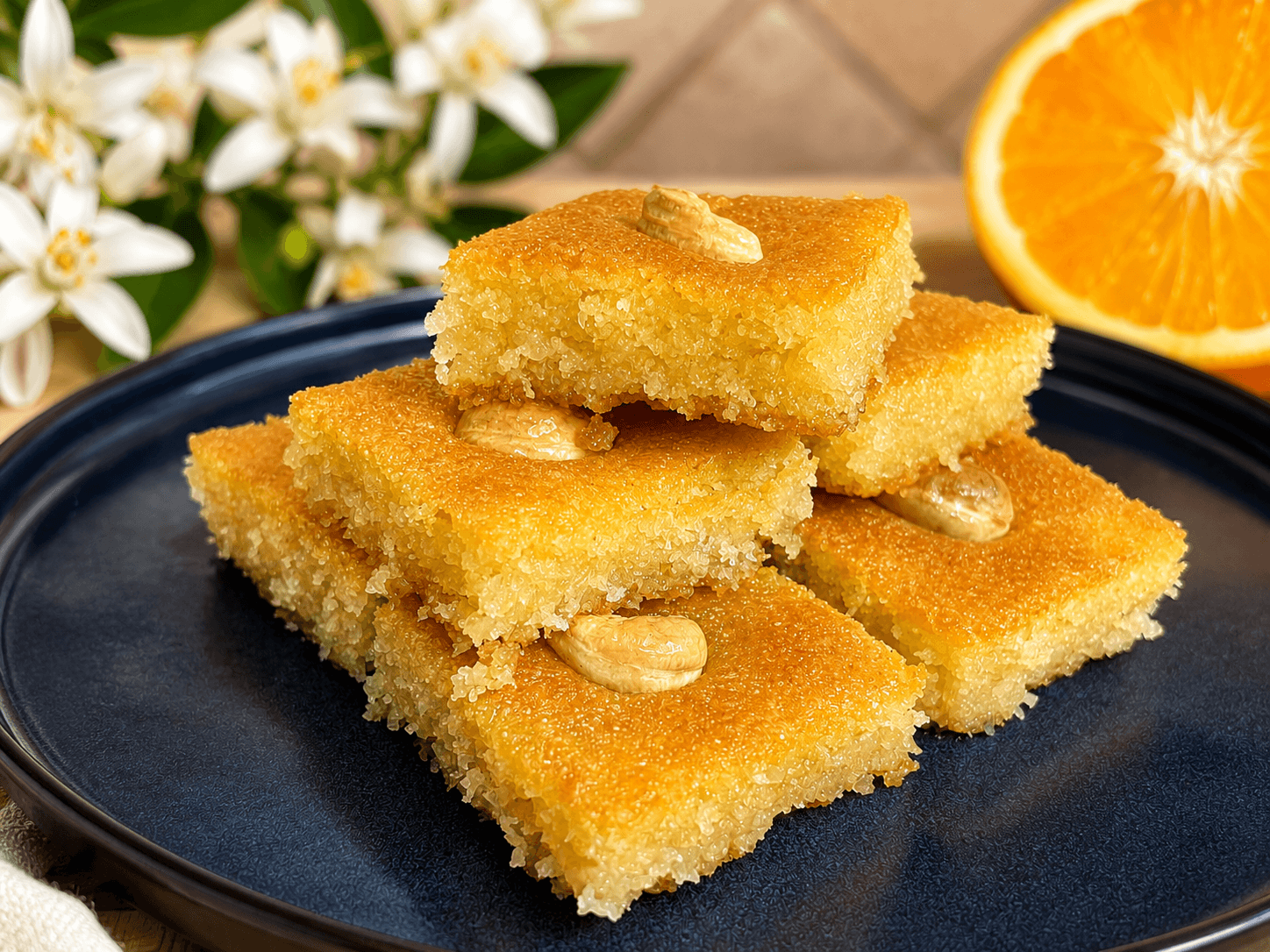
There are desserts that impress with their complexity, and then there are desserts that win hearts through simplicity. Lebanese nammoura, also spelled namoora, belongs to the second category. Families across the Levant and the Arab world transform a handful of humble pantry ingredients into one of the region’s most beloved desserts.
For many of us, nammoura is not just a dessert. It is a memory of family gatherings, Sunday visits to grandparents, trays of sweets shared with neighbors, and the smell of sugar syrup filling the kitchen. It sits proudly beside other traditional desserts that shaped our childhoods, such as meghleh, mhallabieh, riz bi halib (rice pudding), and sfouf.
Today, this beloved semolina dessert is known by different names throughout the Middle East and beyond. While Lebanese families know it as nammoura, Egyptians proudly call it basbousa, a name that has become famous worldwide. In parts of Syria and Palestine, it is often referred to as hareeseh or harissa, whereas in Turkey, a closely related version is known as revani. Although each country has developed its own traditions, flavors, and techniques, these desserts all belong to the same culinary family. At their heart lies a simple yet irresistible combination of semolina and fragrant syrup that has delighted generations across the region.
What Is Nammoura?
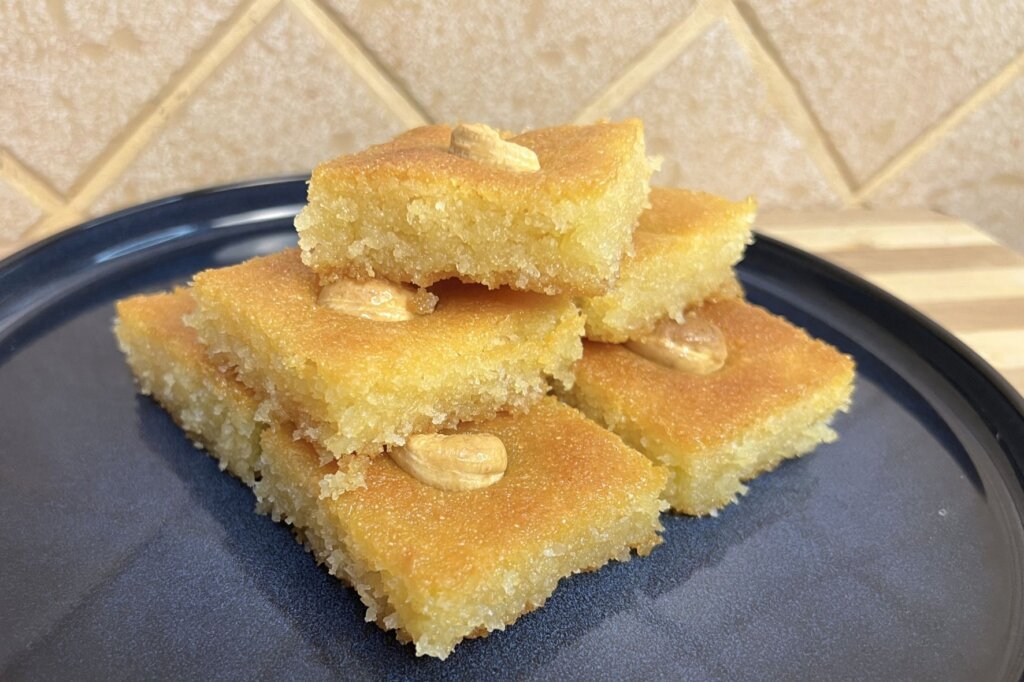
Nammoura is a traditional Lebanese semolina cake baked until golden and then soaked with a sugar syrup flavored with lemon juice and often orange blossom water. The cake is usually cut into squares or diamonds before baking and decorated with almonds or pine nuts.
Its texture is what makes it special. Unlike regular cakes made with flour, nammoura has a slightly grainy texture from semolina. Once soaked with syrup, it becomes moist, tender, and wonderfully aromatic.
Many Lebanese families serve nammoura with coffee after lunch or during afternoon visits. It is also common during religious celebrations, family gatherings, and festive occasions.
What makes nammoura particularly special is that it represents the traditional Lebanese philosophy of dessert making: transforming simple ingredients into something memorable.
My Story with Lebanese Nammoura
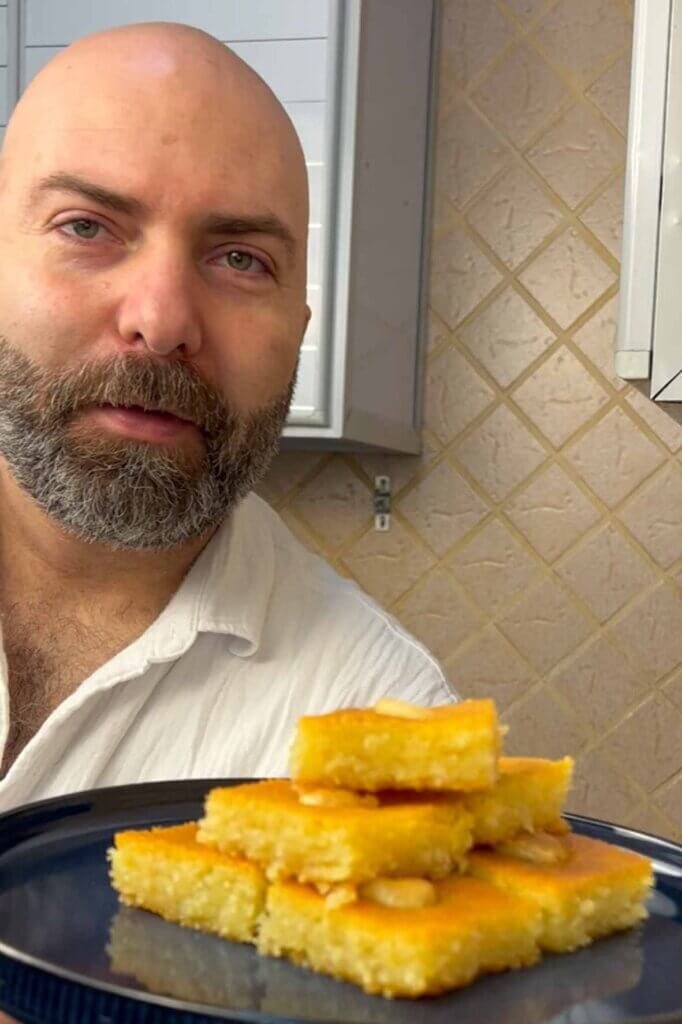
Growing up in Lebanon, desserts were never reserved for special occasions only. There was always something sweet waiting in the kitchen.
My earliest memories include bowls of mhallabieh cooling on the counter, rice pudding scented with orange blossom water, trays of yellow sfouf prepared on weekends, and of course, pieces of freshly baked nammoura dripping with syrup.
Nammoura was one of those desserts that always seemed to appear when guests were expected. The tray would be cut into neat diamonds before entering the oven. Each piece would receive its almond on top like a small crown. Then came the most satisfying moment: pouring the syrup over the hot cake and hearing the gentle sizzling sound as the cake absorbed every drop.
As children, we could hardly wait for it to cool. We would sneak into the kitchen hoping to grab a corner piece before anyone noticed.
Years later, despite working with countless international desserts and pastries, I still find myself returning to traditional Lebanese sweets. They carry stories, traditions, and memories that no modern dessert can replace.
The Importance of Traditional Lebanese Desserts
Lebanese cuisine is famous worldwide for its mezze, grilled meats, and fresh salads. Yet our desserts tell an equally important story.
Unlike many modern sweets that rely heavily on cream, chocolate, or elaborate decorations, traditional Lebanese desserts focus on texture, fragrance, and balance.
Ingredients such as semolina, rice flour, milk, orange blossom water, rose water, cinnamon, and nuts appear repeatedly throughout our dessert traditions.
These ingredients form the foundation of some of Lebanon’s most beloved sweets:
Meghleh
Prepared to celebrate the birth of a child, meghleh combines rice flour with cinnamon, caraway, and anise. It is traditionally decorated with nuts and coconut and symbolizes joy and celebration.
Mhallabieh
This silky milk pudding is one of the simplest and most elegant desserts in Lebanese cuisine. Flavored with orange blossom water, it is often topped with pistachios and served chilled.
Rice Pudding
Known as riz bi halib, this comforting dessert combines rice, milk, and fragrant floral waters. It remains one of the most nostalgic desserts in many Lebanese homes.
Sfouf
Bright yellow from turmeric, sfouf is a semolina cake that shares similarities with nammoura. However, it is typically drier, less sweet, and often enjoyed with tea.
Nammoura
Among all these desserts, nammoura occupies a unique place. It combines the simplicity of sfouf with the indulgence of syrup-soaked sweets, creating a dessert that feels both humble and luxurious.
Nammoura vs Basbousa: Are They the Same?
One of the most common questions people ask is whether nammoura and basbousa are actually the same dessert.
The answer is both yes and no.
At their core, both desserts are semolina cakes soaked in syrup. They share the same general concept and likely descend from similar historical recipes that spread throughout the Ottoman Empire and the Arab world.
However, regional traditions have created noticeable differences.
Lebanese Nammoura
In Lebanon, nammoura is typically made with:
- Semolina
- Yogurt
- Butter or ghee
- Sugar
- Baking powder
- Orange blossom water
- Almond garnish
The texture tends to be dense, moist, and rich.
Egyptian Basbousa
Egyptian basbousa often includes:
- Semolina
- Yogurt
- Butter
- Coconut
- Sugar syrup
- Almonds or other nuts
Many Egyptian recipes incorporate shredded coconut directly into the batter, creating a slightly different texture and flavor profile.
Syrian Hareeseh
Syrian versions often resemble Lebanese nammoura but may vary in sweetness levels and syrup flavorings. Some recipes include rose water while others focus on orange blossom water.
Turkish Revani
Turkish revani often includes eggs, which create a lighter and more cake-like texture compared to the denser Lebanese version.
Which Countries Call It Basbousa?
The name “basbousa” is most strongly associated with Egypt, where it is considered one of the country’s most iconic desserts.
However, the dessert appears under different names across the region:
| Country | Common Name |
|---|---|
| Lebanon | Nammoura |
| Egypt | Basbousa |
| Syria | Hareeseh / Harissa |
| Jordan | Basbousa or Hareeseh |
| Palestine | Hareeseh |
| Turkey | Revani |
| Greece | Ravani |
| Tunisia | Harissa (dessert version) |
Although the names differ, the concept remains remarkably similar: semolina baked and soaked in syrup.
A Dessert with Ottoman Roots
Food historians generally agree that syrup-soaked semolina cakes spread widely during the Ottoman period. Variations emerged across the Middle East, North Africa, the Balkans, and parts of the Mediterranean. Over time, each region adapted the recipe according to local tastes and available ingredients.
This explains why similar desserts appear in so many countries while maintaining their own unique identities.
The Lebanese version emphasizes orange blossom water and a rich semolina texture. Egyptian basbousa often highlights coconut. Turkish revani introduces eggs for a lighter crumb.
Yet all these desserts remain members of the same culinary family.
Why Semolina Is Essential
The secret to nammoura lies in semolina.
Unlike wheat flour, semolina creates a texture that is simultaneously tender and slightly coarse. It absorbs syrup beautifully without becoming mushy.
This characteristic allows the cake to remain moist for days while maintaining its structure.
Semolina is one of the most important ingredients in Middle Eastern and Lebanese baking.
Beyond nammoura, it appears in many traditional recipes that have been passed down through generations.
It gives structure and texture to desserts such as sfouf, knefeh, maamoul, and many regional versions of basbousa and hareeseh.
Semolina is also used in savory preparations, including certain breads and pasta-like dishes.
In Lebanese kitchens, it has long been valued for its ability to create desserts that are both satisfying and rustic.
Its unique texture is part of what makes so many traditional sweets instantly recognizable and deeply connected to our culinary heritage.
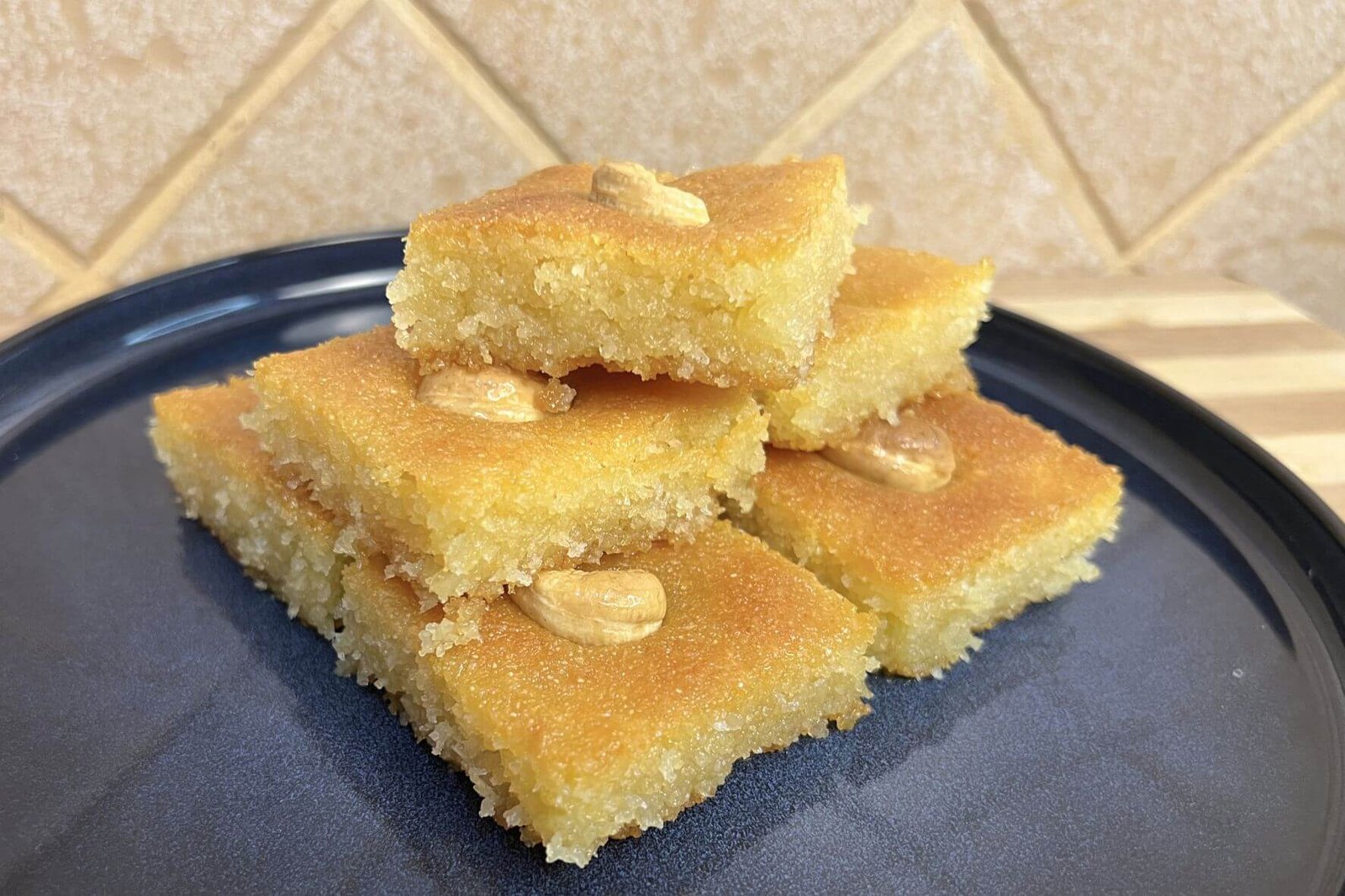
Nammoura
Ingredients
Equipment
Method
- In a large bowl, combine the coarse semolina, sugar, shredded coconut, and baking powder.
- Use a whisk to ensure everything is evenly distributed.
- Add the yogurt to the dry mixture.
- Start mixing by hand (or with a glove) to knead the dough until it forms a thick, stiff consistency.
- Pour in a small amount of melted butter and continue kneading until the dough is smooth and homogenous.
- Cover the bowl tightly with plastic wrap.
- Let the dough rest at room temperature for 20 to 30 minutes.
- You will notice a bit of moisture from the yogurt rising to the surface; this is normal.
- Spread a thin layer of Tahini across the bottom and sides of your baking pan.
- This adds a unique flavor and ensures the cake doesn’t stick.
- Knead the rested dough slightly, then transfer it to the pan.
- Spread it out evenly using your hands, ensuring a uniform thickness across the entire tray.
- Let the dough rest in the pan for an additional 10 minutes before baking.
- Using a knife, lightly score the surface of the dough into a diamond or square pattern.
- Place a cashew or almond in the center of each piece.
- Place in the oven and bake for approximately 35 minutes, or until the top is a deep golden brown.
- Immediately after removing the Namoura from the oven, pour the sugar syrup (Qatr) over the hot cake.
- Ensure the syrup is distributed evenly so it can be fully absorbed.
- Allow the cake to cool completely (ideally overnight) so it sets and the flavors meld.
- Cut along the scored lines and serve.
Video
The Magic of Sugar Syrup
Every great nammoura depends on its sugar syrup. While the semolina provides the structure and texture, the syrup is what transforms a simple cake into the moist and irresistible dessert we all know and love.
The syrup adds sweetness, keeps the cake tender, and helps preserve its freshness for several days. In many Lebanese homes, it is flavored with orange blossom water, rose water, or a combination of both, giving nammoura its distinctive aroma. The timing is equally important. Pouring the syrup over the cake while one is hot and the other is cool allows the semolina to absorb the liquid evenly, creating the perfect balance between moisture and texture.
Although sugar syrup may seem simple, getting the proportions right can make a significant difference in the final result. If you would like to learn exactly how I prepare the syrup for my Lebanese nammoura, be sure to check the recipe, where I share the complete method and tips for achieving the perfect consistency every time.
The Role of Orange Blossom Water
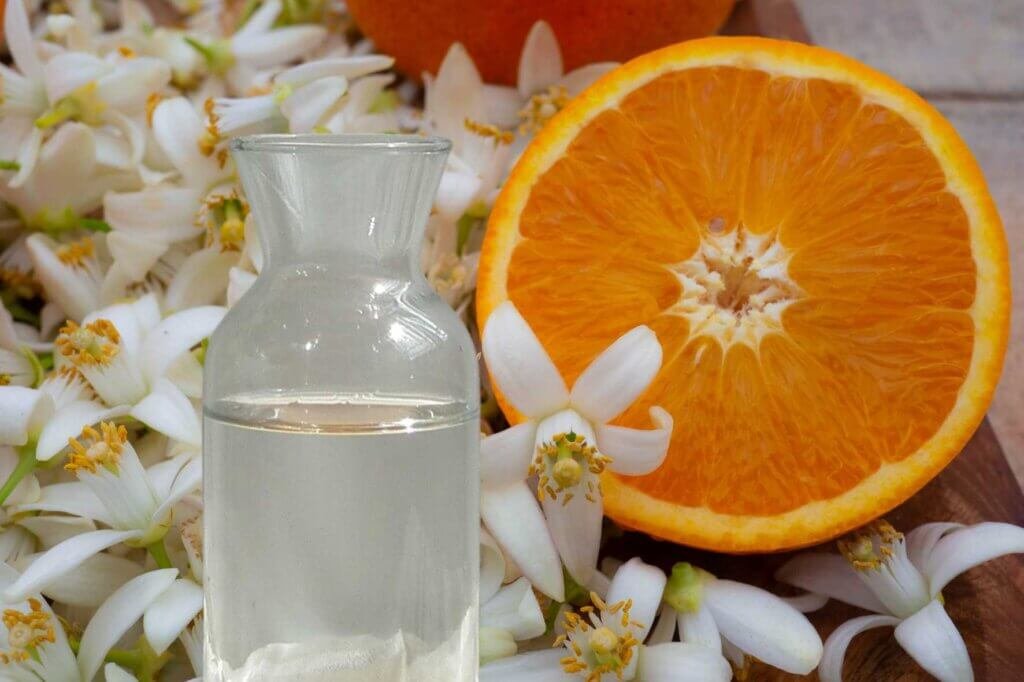
If there is one ingredient that instantly transports me back to childhood, it is orange blossom water. More than a flavoring, it is a scent deeply connected to my hometown of Maghdouché in southern Lebanon, a town well known for its citrus groves and the production of orange blossom water.
Memories of Spring in Maghdouché
Every spring, when the orange trees burst into bloom, the entire town seems to change. The air becomes filled with a sweet floral perfume that drifts through the streets, gardens, and orchards. Even today, whenever orange blossom season arrives, that familiar scent immediately brings back memories of my childhood.
As children, my siblings and I would often help our parents gather the delicate white blossoms. The flowers had to be picked carefully and gently, usually in the early morning when their fragrance was at its strongest. What felt like a chore at the time became one of the memories I treasure most today.
Once enough blossoms had been collected, the real magic began. I remember watching my father prepare the traditional distillation equipment used to transform those fragrant flowers into orange blossom water. The process seemed fascinating to me. Large quantities of blossoms were carefully placed into the still, heated slowly, and transformed into the precious aromatic liquid that would later find its way into countless Lebanese recipes.
The smell that filled our home during those days was unforgettable. Every room carried the perfume of fresh blossoms, and the scent lingered for days afterward. For many families in Maghdouché, producing orange blossom water was more than a culinary tradition. It was part of our identity and our connection to the land.
Orange Blossom Water in Lebanese Desserts
Of course, orange blossom water plays an important role in Lebanese desserts. It adds elegance and fragrance to classics such as rice pudding, mhallabieh, meghleh, knefeh, and nammoura. Its delicate floral notes bring balance to sweet recipes without overpowering them. A small amount can completely transform a dessert, giving it the unmistakable flavor that so many of us associate with Lebanese hospitality and home cooking.
In Lebanese nammoura, orange blossom water is often added to the syrup, where it perfumes every bite of the semolina cake. The result is subtle yet distinctive. It is one of those flavors that many people may not immediately identify, yet they instantly recognize it as the taste of a traditional homemade dessert.
For me, however, orange blossom water is more than an ingredient. It is the scent of spring in Maghdouché, the memory of helping my parents in the orchards, watching my father carefully make the water, and seeing our town come alive with the fragrance of millions of blossoms. Every time I prepare a dessert flavored with orange blossom water, I am reminded not only of Lebanese cuisine but also of home.
Why Nammoura Remains Popular Today
Despite changing food trends, nammoura continues to thrive.
There are several reasons for its enduring popularity:
Affordable Ingredients
Most ingredients are inexpensive and easy to find.
Easy Preparation
Even beginner bakers can achieve excellent results.
Excellent Shelf Life
The syrup helps preserve moisture for several days.
Perfect for Gatherings
A single tray can serve many people.
Deep Cultural Roots
Perhaps most importantly, nammoura connects generations through shared memories and traditions.
Serving Suggestions
Nammoura is delicious on its own, but it pairs beautifully with several beverages.
Arabic Coffee
The slight bitterness of coffee balances the sweetness of the syrup.
Tea
Black tea provides a classic pairing enjoyed throughout the region.
Milk
Many children enjoy nammoura alongside a cold glass of milk.
Fresh Fruit
Seasonal fruit can provide a refreshing contrast to the richness of the cake.
Tips for the Perfect Lebanese Nammoura
For the best results:
- Use good-quality semolina.
- Allow the batter to rest before baking.
- Cut the cake before it enters the oven.
- Do not skip the syrup.
- Use fresh orange blossom water.
- Allow sufficient time for absorption before serving.
These simple steps make a remarkable difference.
More Than Just a Dessert
When I think about nammoura, I do not think only about semolina, syrup, or almonds.
I think about family visit, about trays cooling on kitchen counters.
I think about grandparents serving coffee. About celebrations, conversations, and traditions passed from one generation to the next.
Like meghleh, mhallabieh, rice pudding, and sfouf, nammoura is part of a larger story. It reminds us that food is never just food. It carries memories, culture, and identity.
That is why, even today, a simple piece of Lebanese nammoura can instantly transport us back to childhood.
And perhaps that is the greatest ingredient of all.

Chef François El Aaraj is a corporate chef and culinary consultant with more than 30 years of experience in professional kitchens and restaurant openings across Lebanon and abroad. Through this website, he shares authentic recipes, cooking techniques, and chef secrets designed to help home cooks create flavorful meals with confidence.
Leave a Reply