There are desserts that satisfy a craving, and then there are desserts that tell a story. Lebanese meghleh belongs firmly in the second category. It is more than a sweet dish. It is a symbol of celebration, family, generosity, and heritage. Every spoonful carries memories that stretch back generations.
Unlike modern desserts that come and go with trends, meghleh has remained a beloved part of Lebanese culture for centuries. Whether it is served to celebrate the birth of a new baby, shared during Christmas festivities in traditional villages, or enjoyed from a small plastic container purchased at a neighborhood restaurant, meghleh continues to connect us to our roots.
Today, I am sharing not only my favorite meghleh recipe but also the story behind this remarkable Lebanese dessert and why it continues to hold a special place on our tables.
What Is Meghleh?
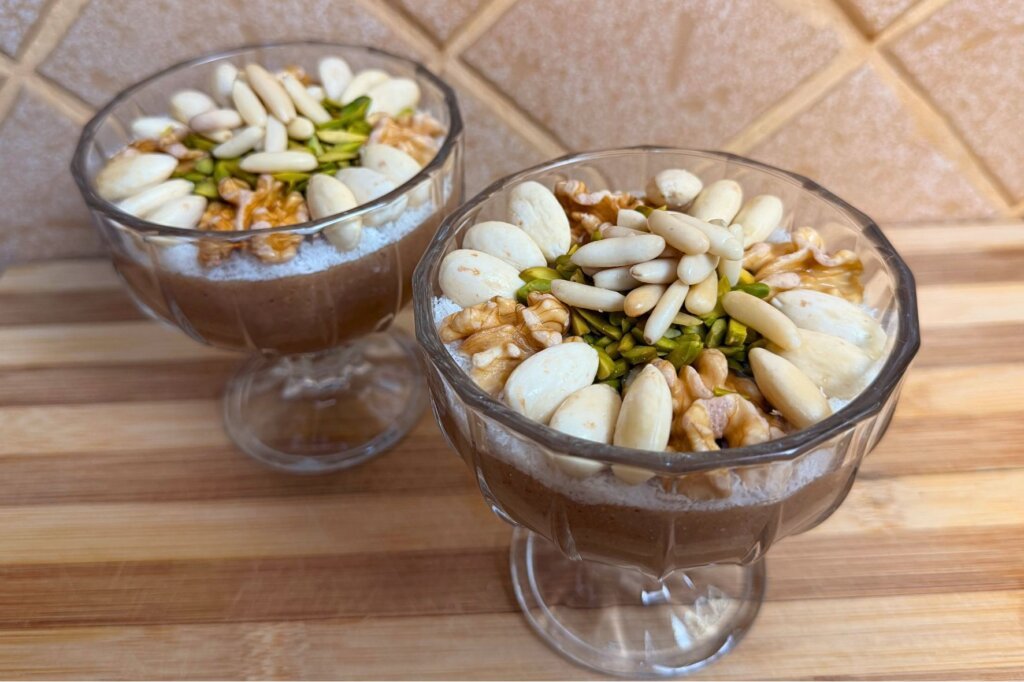
Meghleh is a traditional Lebanese rice pudding made with rice flour, sugar, cinnamon, caraway, and anise. Unlike the white rice puddings found in many parts of the world, meghleh has a rich brown color that comes from its generous amount of spices.
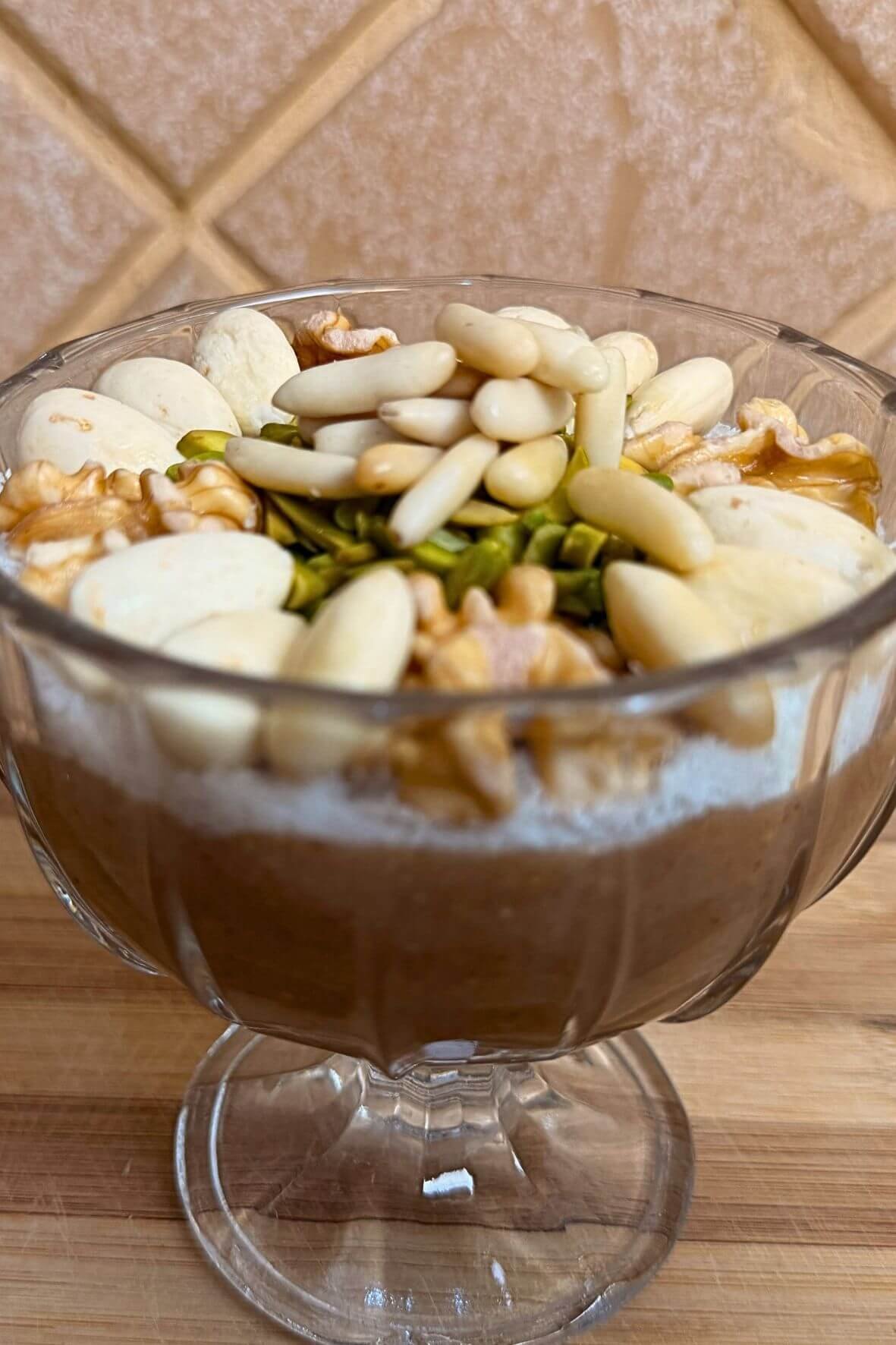
Once cooked, the pudding is poured into serving cups and left to cool. It is then topped with a beautiful assortment of nuts and shredded coconut. Almonds, pistachios, walnuts, pine nuts, and coconut create a colorful contrast against the dark pudding beneath.
The result is a dessert that is fragrant, comforting, and surprisingly light despite its rich appearance.
The aroma alone can transport many Lebanese people back to childhood kitchens filled with warmth and anticipation.
My Story With Meghleh
Some foods are tied to specific moments in life, and Lebanese meghleh is certainly one of them.
As a child, I remember seeing trays of meghleh appear whenever a family welcomed a newborn baby. Relatives, neighbors, and friends would come to offer congratulations, and bowls of meghleh would be prepared in large quantities to share with everyone.
The house would be filled with visitors carrying gifts, flowers, and good wishes. Somewhere in the kitchen, someone was always carefully decorating cups of meghleh with nuts and coconut.
As children, we were fascinated by the toppings. We would compare bowls to see who had received the most pistachios or the biggest almond.
Back then, I didn’t fully understand the significance of the tradition. I simply knew that a new baby meant delicious meghleh was coming.
Years later, I came to appreciate how food plays a role in marking life’s most important moments. Meghleh is not merely a dessert. It is part of a celebration of new life.
Why Is Meghleh Served After Childbirth?
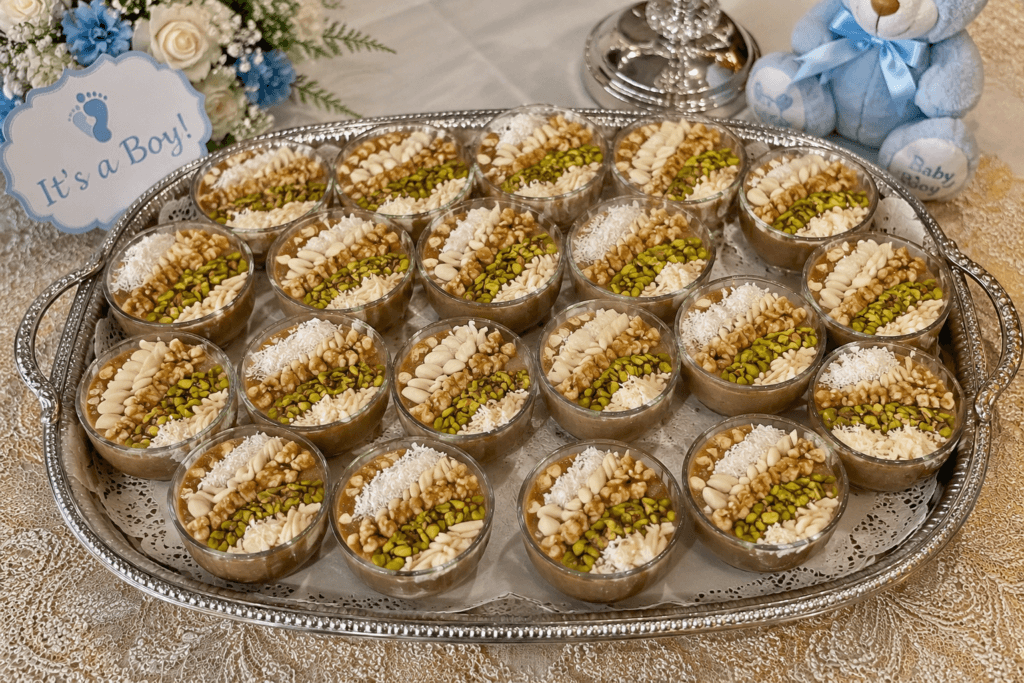
One of the most beautiful Lebanese traditions is serving meghleh after the birth of a child.
Historically, many believed that the warming spices used in Lebanese meghleh, particularly cinnamon, caraway, and anise, were beneficial for new mothers. The spices were thought to provide comfort and nourishment during recovery after childbirth.
Whether for nutritional reasons or symbolic ones, the tradition became deeply rooted in Lebanese culture.
Family members prepare large quantities of meghleh and distribute it to relatives, friends, neighbors, and visitors who come to congratulate the parents.
In many Lebanese homes, it is difficult to imagine welcoming a newborn without trays of beautifully decorated meghleh cups waiting on the table.
Even today, despite changing lifestyles and modern celebrations, this custom remains alive and well.
Lebanese Meghleh and Christmas Traditions
Jump to Recipe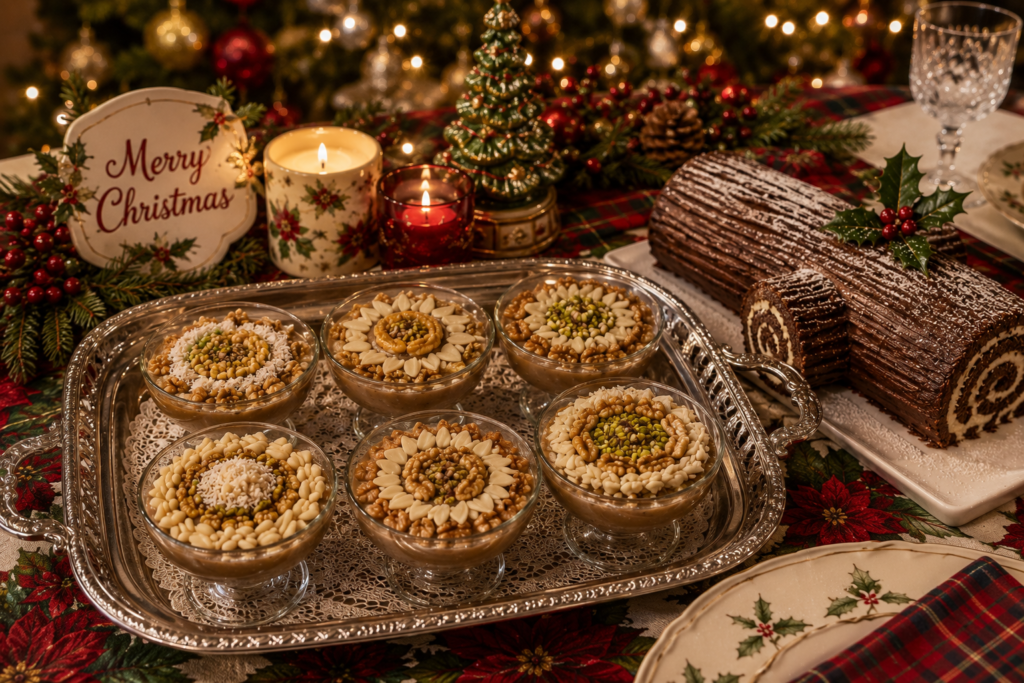
While most people immediately associate meghleh with childbirth celebrations, there is another beautiful tradition that many people outside Lebanon may not know.
In some Lebanese villages and older towns, meghleh is also prepared during the Christmas season.
Today, many Christmas tables feature modern desserts such as cakes, cookies, and the famous yule log. These desserts have become increasingly popular and are often the centerpiece of holiday gatherings.
Yet in many traditional homes, particularly in older generations, meghleh still finds its place during Christmas celebrations.
Its warm spices feel perfectly suited to winter. The fragrance of cinnamon, anise, and caraway filling the kitchen creates a sense of comfort that matches the festive atmosphere of the season.
For many families, preparing meghleh during Christmas is a way of preserving tradition while celebrating faith, family, and heritage.
It serves as a reminder that some recipes are too meaningful to disappear, even as new culinary trends emerge.
The Beauty of Traditional Lebanese Desserts
One thing I have always loved about Lebanese food culture is how we preserve traditional recipes.
Walk into many fast-food restaurants, bakeries, snack shops, or neighborhood eateries across Lebanon and you will often find a small refrigerated display filled with simple desserts.
Among the cakes and pastries, you may still discover small plastic containers holding traditional sweets.
Mhallabieh.
Custard.
Meghleh.
These desserts may not have elaborate decorations or expensive ingredients. They are simple, humble, and familiar.
Yet they continue to sell because they evoke memories.
People often buy them not because they are looking for luxury, but because they are looking for comfort.
A spoonful of mhallabieh can remind someone of their grandmother’s kitchen. A cup of rice pudding may bring back memories of childhood. And a serving of Lebanese meghleh can instantly transport someone to a family celebration.
There is something beautiful about the fact that these traditional desserts continue to survive alongside modern pastries and international sweets.
They represent a connection to our identity.
Lebanese Meghleh and Its Variations Across the Levant
Although many people associate Lebanese meghleh primarily with Lebanon, versions of this fragrant dessert can be found throughout the Levant. Like many traditional dishes that have traveled across borders for centuries, meghleh has evolved differently from one country to another while preserving its essential character as a spiced pudding made for special occasions.
In Lebanon, meghleh is most closely linked to the celebration of a newborn child. Families prepare large quantities and distribute it to relatives, friends, neighbors, and visitors who come to offer their congratulations. Lebanese meghleh is typically made with rice flour, cinnamon, caraway, and anise, then generously topped with coconut, almonds, walnuts, pistachios, and pine nuts. It is often served in individual cups decorated with great care, turning each portion into a small edible work of art.
Regional Variations of Meghleh
In Syria, particularly in Damascus and other major cities, similar versions of meghleh are also prepared, though the balance of spices may vary from family to family. Some Syrian recipes use a stronger spice profile, while others focus more heavily on cinnamon. Like many Syrian desserts, presentation is highly valued, and the pudding is often decorated generously with nuts.
In Palestine and Jordan, spiced puddings resembling meghleh are also known, though they may appear under different names depending on the region. Some families prepare them during celebrations, religious holidays, or family gatherings rather than specifically for childbirth. The toppings and spice blends often reflect local tastes and available ingredients.
A Shared Culinary Heritage
What I find fascinating is that there is no single “correct” version of meghleh throughout the Levant. Every family seems to have its own recipe, its own preferred balance of spices, and its own way of decorating the surface. Some use more caraway, others add extra cinnamon, and some create intricate patterns with nuts while others keep the presentation simple.
This diversity is part of what makes Levantine cuisine so special. The same recipe can travel from one village to another, from one country to the next, and gradually evolve while still remaining recognizable. Lebanese meghleh is a wonderful example of how food connects the people of the Levant through a shared culinary heritage while allowing each community to express its own traditions and identity.
Lebanese Meghleh
Ingredients
Equipment
Method
- In a small pot (rakweh), bring a portion of the water to a boil.
- Add the whole anise seeds.
- Let them boil for a minute, then remove from heat and let them steep aside.
- In a large pot (off the heat/while cold), combine the remaining water and the rice flour.
- Add the sugar.
- Stir well until the rice flour and sugar are completely dissolved to prevent clumping.
- Add the caraway and cinnamon powders to the rice mixture.
- Strain the prepared anise water into the main pot, discarding the seeds.
- Stir everything together until the color is uniform.
- Place the pot over very low heat.
- Stir constantly. It is crucial to cook it slowly on low heat to allow the rice grains to expand properly without evaporating the water too quickly.
- Continue cooking for about 20 minutes.
- To check if it is ready, use the “finger test”: Dip a spoon into the mixture and draw a line through the back of it with your finger. If the line stays clear and the mixture doesn’t run, it has reached the perfect thickness.
- Pour the hot mixture into small serving bowls.
- Do not fill them to the very top to leave room for the toppings.
- Let the pudding cool.
- Toppings: Generously cover the surface with desiccated coconut.
- Add the soaked walnuts, peeled almonds, pistachios, and pine nuts.
Video
Notes
Why Lebanese Meghleh Remains Popular Today
Many traditional recipes disappear over time because they require too much effort or because tastes change.
Meghleh has managed to survive because it offers something timeless. its ingredients are simple, the preparation is straightforward, and the flavor is unique.
And most importantly, it carries emotional significance.
People do not simply eat meghleh because it tastes good. They eat it because it reminds them of family gatherings, celebrations, births, holidays, and childhood memories.
A Naturally Vegan Dessert for Modern Lifestyles
Another reason for meghleh’s continued popularity is that it naturally fits modern dietary trends. Long before vegan desserts became fashionable, meghleh was already a plant-based sweet. Made with rice flour, sugar, water, and aromatic spices, it contains no dairy, eggs, or butter. This makes it an excellent option for those following a vegan lifestyle or anyone looking for a dairy-free dessert.
Today, more people are searching for desserts that are both satisfying and plant-based. Many vegan desserts rely on expensive specialty ingredients or complicated preparation methods. Meghleh, on the other hand, has been proving for generations that a simple vegan dessert can be rich in flavor, beautiful to serve, and deeply comforting.
What I find particularly fascinating is that a dessert deeply rooted in Lebanese tradition has become perfectly suited to modern eating habits. While food trends constantly evolve, meghleh remains relevant because it offers something that many people are looking for today: a dessert that is easy to prepare, made with pantry-friendly ingredients, naturally vegan, and genuinely delicious.
Whether you are preparing it to celebrate a newborn, serve it during the holidays, or simply enjoy a comforting homemade dessert, meghleh demonstrates that some of the best vegan recipes are not new inventions at all. They are traditional dishes that have stood the test of time.
When a Vegan Friend Discovered Lebanese Meghleh
One of my favorite memories involving Lebanese meghleh happened when a dear friend came to visit us from London. She is a professional baker who specializes in vegan cakes and desserts, and for many years she has followed a vegan lifestyle herself.
A Naturally Vegan Lebanese Dessert
It was her first visit to Lebanon, and like many visitors, she was eager to discover the foods that are part of our daily lives. During her stay, my mother-in-law happened to prepare a large batch of meghleh. There was no special occasion and no newborn to celebrate. She simply makes it from time to time because my children absolutely love it. In our home, meghleh is not reserved only for traditions and celebrations; it is a dessert we genuinely enjoy throughout the year.
When my friend saw the cups of meghleh topped with coconut, almonds, walnuts, pistachios, and pine nuts, she was immediately intrigued. After her first spoonful, she was completely amazed. She could hardly believe that something so flavorful, aromatic, and satisfying contained no dairy, eggs, cream, or butter.
As a vegan baker, she was used to seeing complicated ingredient lists designed to replace traditional dairy products. Yet here was a centuries-old Lebanese dessert that was naturally vegan without trying to be. There were no substitutes, no special ingredients, and no modern adaptations. It had simply been prepared the same way Lebanese families had been making it for generations.
I still remember her asking for the recipe before she left. She was fascinated by the idea that a traditional Middle Eastern dessert could fit perfectly into a modern vegan lifestyle while remaining authentic to its roots. Watching her discover meghleh reminded me of something I sometimes forget many of our traditional Lebanese recipes are not only delicious and meaningful, but surprisingly relevant to the way many people choose to eat today.
The Secret Behind Great Meghleh
A truly good meghleh should be smooth and silky.
It should not feel grainy.
It should not be too thick or too thin.
The spices should be noticeable but balanced.
The texture should be delicate enough to melt in the mouth while still holding its shape in the serving cup.
What Makes Lebanese Meghleh Perfect?
The secret lies in patience.
Rice flour must be properly dissolved before cooking begins. The mixture should be stirred continuously to prevent lumps from forming, and the spices need enough time to infuse the pudding and develop their full flavor.
Traditionally, making meghleh was no small task. Our grandmothers and great-grandmothers often simmered it for nearly two hours while stirring constantly. It was hard work, especially at a time when electric mixers and modern kitchen appliances did not exist. This is one of the reasons why Lebanese meghleh was usually reserved for special occasions such as the birth of a child or major family celebrations. Preparing a large batch required both time and dedication.
Tradition Meets Modern Life
Over the years, however, our lifestyles have changed dramatically. Most of us juggle work, family, responsibilities, and countless daily commitments. While I deeply respect traditional methods, I also believe that recipes should evolve to remain practical for modern households.
That is why in my version, I simmer the meghleh for only about 20 minutes. Despite the shorter cooking time, the result is still smooth, fragrant, rich in flavor, and loved by everyone who tastes it. My goal is always to create recipes that preserve tradition while adapting them to the faster pace of modern life.
When I shared my meghleh recipe on YouTube, I received many comments insisting that “real meghleh” must be simmered for at least an hour and a half. What made me smile was that nearly all of those comments came from ladies over the age of sixty. We all know how attached certain generations can be to the cooking methods they learned from their mothers and grandmothers, and I completely understand their point of view. In many ways, those long cooking times are part of their memories and traditions.
For me, however, good food should be accessible. If a recipe can be simplified without sacrificing quality, it becomes more likely that younger generations will continue preparing it. After all, a tradition survives not because it remains unchanged, but because each generation finds a way to make it part of their lives. If a delicious bowl of meghleh can be made in 20 minutes instead of two hours, then perhaps more families will continue enjoying this beautiful Lebanese dessert for years to come.
The Importance of the Toppings
If meghleh is the canvas, the toppings are the artwork.
Traditionally, the surface is decorated with shredded coconut, almonds, walnuts, pistachios, and pine nuts.
Each topping contributes something different.
The coconut adds sweetness and texture.
The almonds provide crunch.
The walnuts offer richness.
The pistachios bring vibrant color.
The pine nuts contribute their distinctive buttery flavor.
Beyond taste, the toppings transform each cup into a beautiful presentation worthy of a celebration.
In many homes, decorating the cups becomes a family activity, with everyone adding their own artistic touch.
Nutritional Benefits of Meghleh
Although meghleh is primarily considered a dessert, several of its ingredients offer nutritional value.
Cinnamon
Cinnamon contains antioxidants and contributes its warm, comforting flavor. It has been appreciated for centuries in traditional cuisines around the world.
Anise
Anise adds a distinctive aromatic quality and has long been used in Middle Eastern culinary traditions.
Caraway
Caraway contributes depth and complexity while providing the characteristic flavor that makes meghleh unique.
Nuts
The nuts used for topping provide healthy fats, protein, vitamins, and minerals while adding satisfying texture.
While meghleh should still be enjoyed as a dessert, these ingredients contribute more than just flavor.
Serving Suggestions
Meghleh is best served chilled after several hours in the refrigerator.
It can be prepared a day in advance, making it an excellent dessert for gatherings and celebrations.
Serve it in individual cups for an elegant presentation or in a large serving dish for family-style dining.
For special occasions, decorate each serving generously with coconut and nuts to create a festive appearance.
Preserving a Piece of Lebanese Heritage
One of the things I value most about recipes like meghleh is that they preserve a part of our cultural identity.
Every family has its own version.
Some add more cinnamon.
Others prefer extra caraway.
Some decorate generously with nuts while others keep it simple.
Yet regardless of the variations, the essence remains the same.
Meghleh is a dessert of celebration.
It is a dessert of hospitality.
It is a dessert of memory.
As long as families continue preparing it for newborn babies, serving it during festive gatherings, and sharing it with loved ones, this beautiful tradition will continue to thrive.
And perhaps that is what makes meghleh truly special.
It is not only a recipe.
It is a story passed from one generation to the next.
And every bowl carries a little piece of that story.

Chef François El Aaraj is a corporate chef and culinary consultant with more than 30 years of experience in professional kitchens and restaurant openings across Lebanon and abroad. Through this website, he shares authentic recipes, cooking techniques, and chef secrets designed to help home cooks create flavorful meals with confidence.
Leave a Reply